“Know thou first, I loved the maid I married; never man Sigh’d truer breath; but that I see thee here, Thou noble thing! more dances my rapt heart Than when I first my wedded mistress saw Bestride my threshold.”
When we took Shakespeare’s “Measure for Measure” into a maximum security woman’s prison on the West Side…there’s a scene there where a young woman is told by a very powerful official that “If you sleep with me, I will pardon your brother. And if you don’t sleep with me, I’ll execute him.” And he leaves the stage. And this character, Isabel, turned out to the audience and said: “To whom should I complain?” And a woman in the audience shouted: “The Police!” And then she looked right at that woman and said: “If I did relate this, who would believe me?” And the woman answered back, “No one, girl.” And it was astonishing because not only was it an amazing sense of connection between the audience and the actress, but you also realized that this was a kind of an historical lesson in theater reception. That’s what must have happened at The Globe. These soliloquies were not simply monologues that people spoke, they were call and response to the audience. And you realized that vibrancy, that that sense of connectedness is not only what makes theater great in prisons, it’s what makes theater great, period.
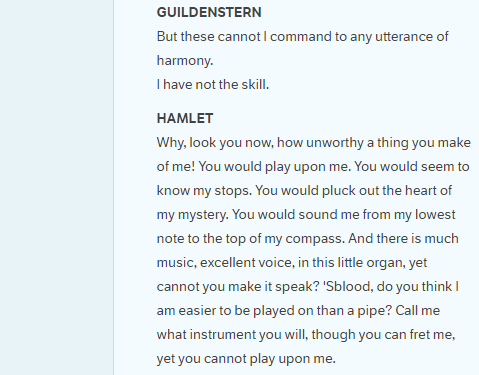
I read Hamlet back in high school and to this day my absolute favorite thing about it was when Guildenstern was trying to fool Hamlet into doing something or other and Hamlet’s savvy to it but rather than saying “you’re lying and trying to trick me” instead Hamlet outta nowhere whips out this flute and tells Guildenstern to play it.
And Guildenstern is all “I dont know how to play a flute, my lord”
And Hamlet takes a dramatic pause before he absolutely ruins Guildenstern with, “Well thats funny considering you thought you could play me”
this post sounds like im exaggerating but im not it’s straight up canon

 alder-knight