Seen in the window at Gulf of Maine Books in Brunswick, Maine.
Photo: Bill Roorbach
Except America wasn’t an endless expanse of forest with no certain borders. At least not while human beings inhabited it. The idea that native peoples did not cultivate or shape our land and that we had no borders is white propaganda meant to dehumanize and de-legitimize native peoples.
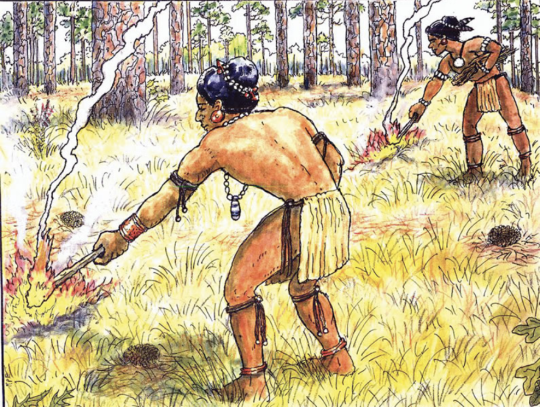
This illustration here show Apalachee people using slash and burn methods for agriculture. Fires were set regularly to intention burn down forests and plains. Why would we do this? Well because an unregulated forest isn’t that great for people, actually. We set fires to destroy new forest growth and undergrowth, and to remove trees, allowing for easier game hunting, nutrient enriched soil, and better growth rates for crops and herbs we used in food and medicine.
Pre-Colonial New England, where my tribe the Abenaki are from, looked more like an extensive meadow or savannah with trees growing in pockets and groves. Enough woodland to support birds, deer, and moose, but not too much to make hunting difficult. We carefully shaped the land around us to suit our needs as a thriving and successful people. Slash and burn agriculture was practiced virtually everywhere in the new world, from the pacific coast to chesapeake bay, from panama to quebec. It was a highly successful way of revitalizing the land and promoting crop growth, as well as preventing massive forest fires that thrive in unregulated forests. Berries were the major source of fruit for my tribe, and we needed to burn the undergrowth so they could grow.
That changed when white people invaded, and brought with them disease. In my tribe, up to 9 in 10 people died. 90% of our people perished not from violence starvation, but from disease. Entire villages would be decimated, struck down by small pox. Suddenly, we couldn’t care for the land anymore. There weren’t enough of us to maintain a vast, carefully structured ecological system like we had for thousands of years. We didn’t have the numbers, or strength. So the trees grew back and unregulated. We couldn’t set fires anymore, and we couldn’t cultivate the land. And white people would make certain we never could again. Timber, after all, was the most important export from New England.
Endless trees and untamed wilderness is a nice fantasy. But it’s a very white fantasy, one that erases the history of my people and of my land. One that paints native peoples are merely parasites leeching off the land, not masters of the earth who new the right balance of hunting and agriculture. It robs us of our agency as people, and takes our accomplishments from us. Moreover, it implies that only white people ever discovered the power to shape the world around them, and that mere brown people can’t possibly have had anything to do with changing our environment.
Don’t bring back untamed wilderness. Bring back my fire setters, my tree sappers, my farmers and my fishers. Bring back my people who were here first.
This Pride month & anniversary of Pulse, please consider donating to orgs that serve LGBTQ people of color and immigrants, and Miss Major’s retirement fund!
Citizens in Puerto Rico laid shoes at the San Juan capitol to represent lost loved ones not counted in the official government death toll. The number is estimated to be 4,645, the official US government number is 64.
Janelle Monáe has landed. Since 2007, she has been beloved for funky records that map out the world of Cindi Mayweather, her android alter-ego who lives in the year 2719. Now, Monáe’s turning the sonic spaceship around. “This album is more near-future,” says a thoughtful yet lighthearted Monáe of Dirty Computer, over lunch a few months before her two big concerts in NYC. “So, for the first time, I’m like, ‘Okay, I’m here now.’ ” The LP, an amalgam of dancy beats, classic R&B and laid-back neo-soul grooves, has an impressive guest list: Grimes, Pharrell, Stevie Wonder, Zoë Kravitz and Brian Wilson all make cameos. More impressively, though, the new effort launches us into the Moonlight and Hidden Figures star’s reality—her feminism and activism, her self-described pansexuality and what it’s like to be black in America today. Pleased to meet you, Janelle.
I love your super-stylized look. Where do you mine your inspiration? I love the ’80s. I’ve been pulling from Bowie, Blondie—just when people didn’t give a fuck about their clothes. It was a vibe. It wasn’t about name brands; it wasn’t about designers. Everything you had on was about how you wanted to express yourself. You didn’t let the trends speak over your art.
Prince, who worked on Dirty Computer, seemed to believe that, too. Prince has been an inspiration to me since I was a little girl. He did, in fact, scare me a lot. I think it was the fact that I had never seen a man express himself like Prince. You just got the sense that this is a free-ass motherfucker, you know? And it inspired my free-ass–motherfucker spirit. And then I got to form a great personal relationship with him. If anybody understood where I was trying to go musically and sonically, it was him. Whatever you needed, he would say, “I’m here.”
Your past few records were set far in the future. Was there a moment in terms of women’s rights that made you think “I need to move to the present”?
It was the whole. It wasn’t just women’s rights; it was also minority rights, poor people’s rights. And if you think about the election—like, Americans voted [Trump] into office, and everything he stands for is so divisive. That right there should be enough to make you feel awake, alive and feel a responsibility.
Was it tough to explore those issues? I really just had to spend time getting to understand myself: How do I talk about these questions that upset me? How do I talk about the sting of being called a bitch for the first time? How do I talk about the sting of feeling like my existence as a minority could get me shot and killed by police? Speaking to Stevie Wonder was a help. He’s on an interlude on the album. I don’t want to misquote him, but it goes: “Do not let your words of anger get in the way of your expressions of love.” I think this album is rooted in that.
What narratives drive Dirty Computer? I think the narrative first comes from a young African-American woman living in America through my lens. You take off the makeup, the costumes, the artist—I am the daughter and descendant of working-class parents and grandparents. My grandmother picked cotton in Aberdeen, Mississippi. She helped build this country, and when I think about being a woman, being a minority and being a queer black woman, I think it makes me feel a deeper responsibility to make sure people who are like me feel seen, are heard and feel celebrated.
On Twitter, Missy Elliott wrote, “I wonder what artist would take a chance on me directing a video for them.” And you essentially did this: [Raises hand]
Oh my god. First of all, I grew up idolizing Missy Elliott. She is the master of visuals, so I would be honored to have her do anything. It’s been a long time coming.
When did you first meet? When I first started my career, I did a showcase here in New York City. I was so nervous. I didn’t look like any of the other artists who were performing that night. My music didn’t sound like them, and I was in this tuxedo and had natural hair. I wasn’t what you would call a “typical” R&B black female artist, and I was really having anxiety about it. I did my thing, and I remember seeing her in the audience. When I came offstage, she was one of the first people to greet me. She told me she loved my performance and thought I had something special. Just the affirmation I got from her right there helped me embrace the things that make me unique.
Who is inspiring you now? I love Cardi B’s authenticity. I think I’m just inspired by strong women. I’m inspired by the #MeToo movement; I’m inspired by Time’s Up. I’m inspired that black people are telling our stories for ourselves. We’re not letting society or the entertainment industry erase our stories—they’re coming out authentic. I’m inspired to be alive during a time when Black Panther is kicking so much ass at the box office. We’re in an incredible time.




 alder-knight