The official story of the Trump administration’s family separation
policy is that it came about as a result of “zero tolerance” in which
every person who could be charged with a crime would be, and that meant
that parents were arrested too, and since the parents were going to
jail, their kids had to be held somewhere.
But as Congress has delved into the process, grilling the Trump
officials who enforced the policy, an even crueler, more awful picture
has emerged.
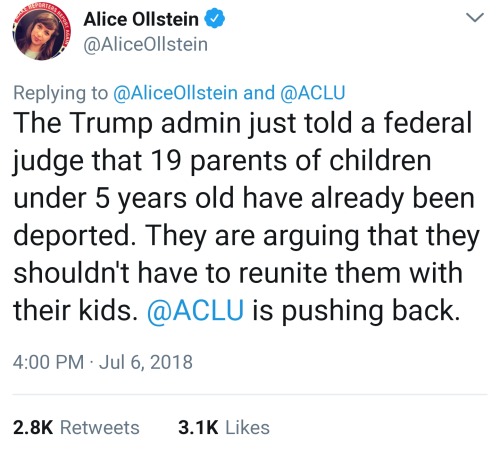
It turns out that border guards charged “less than a third” of the
adults who crossed the border since the policy began – but that they preferentially brought charges against parents so they could take their kids away.
In other words, child separation wasn’t the inadvertent side-effect of a zero-tolerance policy.
There is no zero-tolerance policy. There is only a family separation policy.
What’s sad about this is the government isn’t taking into account what these families go through!It might’ve only been 2 months but he is physically disengaged with his dad,does not know what is happening,why it’s happening, and he’ll be stuck with those feelings/memories forever!
Shits so fucked man. That poor baby. I’m literally sick.
at least we have the restful comfort of knowing the AU where the Dems won in 2016 is no better than this timeline, because both parties are identically bad and “lesser evil” isn’t a thing
and it’s not the same but it’s sticking in my chest because it just rhymes neatly with my first memory of learning about the holocaust
the bars of soap, the promises of showers
it’s not the same, it’s not the same, but baby Alder cried for days after first learning that history, and it’s hitting me right in exactly the same place
My family was Jewish, living in 1942 in the Netherlands when the country was occupied by the Nazis. We children were sent into hiding, with foster families who risked arrest and death by taking us in. They protected us, they loved us, and we were extremely lucky to have survived the war and been well cared for.
Yet the lasting damage inflicted by that separation reverberates to this day, decades hence.
This is my brother writing in recent years. He tries to deal with his lasting pain through memoir. It’s been 76 years, yet he revisits the separation obsessively. He still writes about it in the present tense:
In the first home I scream for six weeks. Then I am moved to another family, and I stop screaming. I give up. Nothing around me is known to me. All those around me are strangers. I have no past. I have no future. I have no identity. I am nowhere. I am frozen in fear. It is the only emotion I possess now. As a three-year-old child, I believe that I must have made some terrible mistake to have caused my known world to disappear. I spend the rest of my life trying desperately not to make another mistake.
My brother’s second foster family cared deeply about him and has kept in touch with him all these years. Even so, he is almost 80 years old now and is still trying to understand what made him the anxious and dysfunctional person he turned into as a child and has remained for the rest of his life: a man with charm and intelligence, yet who could never keep a job because of his inability to complete tasks. After all, if he persisted he might make a mistake again, and that would bring his world to another end.
My younger sister was separated from our parents at five. She had no understanding of what was going on and why she suddenly had to live with a strange set of adults. She suffered thereafter from lifelong, profound depression.
I was older: seven. I was more able than my siblings to understand what was happening and why. I spent most of the war with Dick and Ella Rijnders. Dick was mayor of a small, rural village, and he and Ella lived in a beautiful house next to a wide waterway. Ella had a warm smile and Dick referred to me as his “oldest daughter”. I was able to go to school normally, make friends, and became part of village life. I was extraordinarily lucky, but I was not with my own parents, sister, and brother. And, eventually, I also had to leave the Rijnders, my loving second “family”. I was returning to my own family, but this meant another separation.
In later life, I was never able to really settle down. I lived in different countries and was successful in work, but never able to form lasting relationships with partners. I never married. I almost forgot to mention my own anxiety and depression, and my many years in psychotherapy.
My grief and anger about today’s southern border come not just from my personal life. As a retired psychotherapist who has worked extensively with victims of childhood trauma, I know all too well what awaits many of the thousands of children, taken by our government at the border, who are now in “processing centers” and foster homes – no matter how decent and caring those places might be. We can expect thousands of lives to be damaged, for many years or for ever, by “zero tolerance”. We can expect old men and women, decades from now, still suffering, still remembering, still writing in the present tense.
What is happening in our own backyard today is as evil and criminal as what happened to me and my siblings as children in Nazi Europe. It needs to be stopped immediately.
Calling your immigration bill that makes it easier to deport and punish immigrants and cuts immigration by 25% the “Securing America’s Future Act” is such a loud dog whistle it might as well be a normal whistle.





 alder-knight