what if i told you that a lot of “Americanized” versions of foods were actually the product of immigrant experiences and are not “bastardized versions”
That’s actually fascinating, does anyone have any examples?
I took an entire class about Italian American immigrant cuisine and how it’s a product of their unique immigrant experience. The TL;DR is that many Italian immigrants came from the south (the poor) part of Italy, and were used to a mostly vegetable-based diet. However, when they came to the US they found foods that rich northern Italians were depicted as eating, such as sugar, coffee, wine, and meat, available for prices they could afford for the very first time. This is why Italian Americans were the first to combine meatballs with pasta, and why a lot of Italian American food is sugary and/or fattening. Italian American cuisine is a celebration of Italian immigrants’ newfound access to foods they hadn’t been able to access back home.
(Source: Cinotto, Simone. The Italian American Table: Food, Family, and
Community in New York City. Chicago: U of Illinois, 2013. Print.)
that corned beef and cabbage thing you hear abou irish americans is actually from a similar situation but because they weren’t allowed to eat that stuff due to that artificial famine
❤ FOOD HISTORY ❤
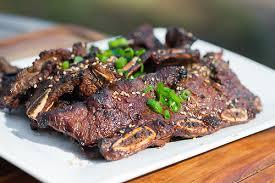
Everyone knows Korean barbecue, right? It looks like this, right?
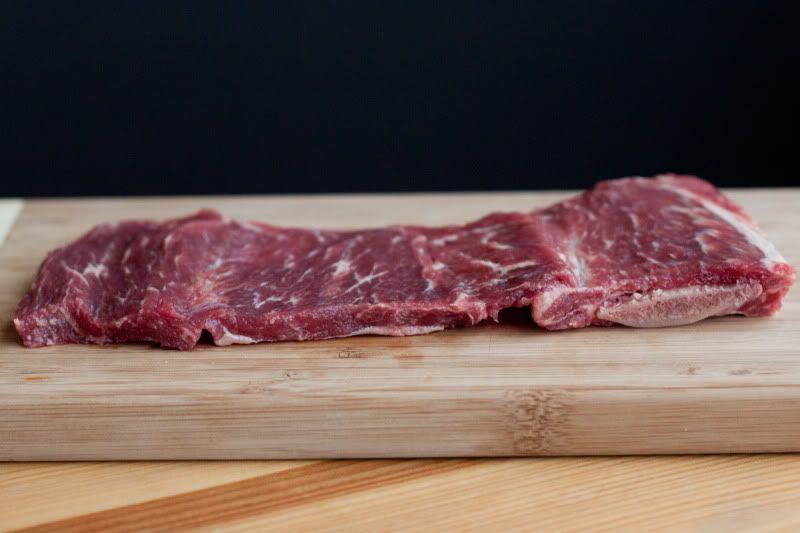
Well, this is called a “flanken cut” and was actually unheard of in traditional Korean cooking. In traditional galbi, the bone is cut about two inches long, separated into individual bones, and the meat is butterflied into a long, thin ribbon, like this:
In fact, the style of galbi with the bones cut short across the length is called “LA Galbi,” as in “Los Angeles-style.” So the “traditional Korean barbecue” is actually a Korean-American dish.
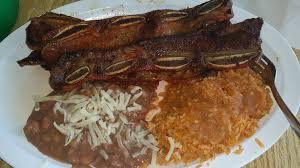
Now, here’s where things get interesting. You see, flanken-cut ribs aren’t actually all that popular in American cooking either. Where they are often used however, is in Mexican cooking, for tablitas.
So you have to imagine these Korean-American immigrants in 1970s Los Angeles getting a hankering for their traditional barbecue. Perhaps they end up going to a corner butcher shop to buy short ribs. Perhaps that butcher shop is owned by a Mexican family. Perhaps they end up buying flanken-cut short ribs for tablitas because that’s what’s available. Perhaps they get slightly weirded out by the way the bones are cut so short, but give it a chance anyway. “Holy crap this is delicious, and you can use the bones as a little handle too, so now galbi is finger food!” Soon, they actually come to prefer the flanken cut over the traditional cut: it’s easier to cook, easier to serve, and delicious, to boot!
Time goes on, Asian fusion becomes popular, and suddenly the flanken cut short rib becomes better known as “Korean BBQ,” when it actually originated as a Korean-Mexican fusion dish!
I don’t know that it actually happened this way, but I like to think it did.
Corned beef and cabbage as we know it today? That came to the Irish immigrants via their Jewish neighbors at kosher delis.
The Irish immigrants almost solely bought their meat from kosher butchers. And what we think of today as Irish corned beef is actually Jewish corned beef thrown into a pot with cabbage and potatoes. The Jewish population in New York City at the time were relatively new immigrants from Eastern and Central Europe. The corned beef they made was from brisket, a kosher cut of meat from the front of the cow. Since brisket is a tougher cut, the salting and cooking processes transformed the meat into the extremely tender, flavorful corned beef we know of today.
The Irish may have been drawn to settling near Jewish neighborhoods and shopping at Jewish butchers because their cultures had many parallels. Both groups were scattered across the globe to escape oppression, had a sacred lost homeland, discriminated against in the US, and had a love for the arts. There was an understanding between the two groups, which was a comfort to the newly arriving immigrants. This relationship can be seen in Irish, Irish-American and Jewish-American folklore. It is not a coincidence that James Joyce made the main character of his masterpiece Ulysses, Leopold Bloom, a man born to Jewish and Irish parents.
The other thing is that corned beef was more expensive in Ireland but cheap in America. Traditionally, it was bacon and cabbage but corned beef replaced that because, just like meatballs, it was something that had previously been a luxury and was now accessible!
“We are being told to eat local and seasonal food, either because other crops have been transported over long distances, or because they are grown in energy-intensive greenhouses. But it wasn’t always like that. From the sixteenth to the twentieth century, urban farmers grew Mediterranean fruits and vegetables as far north as England and the Netherlands, using only renewable energy.
These crops were grown surrounded by massive ‘fruit walls,’ which stored the heat from the sun and released it at night, creating a microclimate that could increase the temperature by more than 10°C (18°F). Later, greenhouses built against the fruit walls further improved yields from solar energy alone.
It was only at the very end of the nineteenth century that the greenhouse turned into a fully glazed and artificially heated building where heat is lost almost instantaneously – the complete opposite of the technology it evolved from.“
So, I just wrote that big thing on ‘progressive’ white America’s modern view of the chattel slavery of African Americans, and I have deiced, on behalf of all white people, we need to stop lying to each other. Teachers, tour guides, even just random people, when they get asked “Was Master X nice to his slaves” or “But most slaves were treated well, right?” Need to uniformly answer “No.”
No owner ever treated a slave well. Not George Washington, Not Thomas Jefferson, not your potential ancestors, not the nice family you heard about on vacation last year. To own another human being is to not treat them well.
We have to stop lying to kids (and each other) and saying that there is a humane way to strip another human being of there right to self, to take a person and create a marketable commodity .
White Americans still benefit from the legacy of slavery, and Black American’s still suffer from it. We need to stop teaching it as an ancient quirk that left few scars because everyone was more or less happy.
It wasn’t symbiotic, it was parasitic, and we need to stop saying otherwise.
To own another human being is to not treat them well.
Aside (in relation to hearing about another conversation): To own another human being, means they cannot give enthusiastic consent to sex. There were no slave and master love stories. The inability to say no to the person who can beat you, kill you, starve you, sell off family members, sell you off away from all you’ve ever known, kill family members and or torture them – means there’s no consent to sex.
No slave master ever fell in love with a slave then treated them right by NOT freeing them and not freeing their family and not supporting abolition.
The fact that a person did not have the full autonomy and were forced to be at the whim of another person is abuse. Period. Slavery was ongoing abuse.
All of these bullshit ‘massa treated me well’ narratives are STOCKHOLM SYNDROME.
THERE IS NO SUCH THING AS A GOOD SLAVE OWNER. THEY ARE ABUSERS. ALL. SLAVE. OWNERS. WERE. VIOLENT. ABUSERS
CW FOR SLAVERY
Want to know a good way to shut down Thomas Jefferson apologists?
Point out the fact that under Virginian standards in Jefferson’s time, the children he fathered on Sally Hemings were white.
Sally Hemings was one quarter black and three quarters white.* She had three white grandparents and one black grandparent in the maternal line.
Jefferson was white. So the children that Jefferson impregnated Sally with were one-eighth black and seven-eighths white. Virginian law during Jefferson’s time stated that a person who had one black great-grandparent was a white person. They were, in the racial parlance of the time, ‘octoroons’ and octoroons were considered white people (NB: THIS IS A VERY LOADED RACIST TERM, AND I’M USING IT HERE FOR EDUCATIONAL PURPOSES, DO NOT USE THIS TERM TO DESCRIBE PEOPLE.) The children were slaves because they were born to an enslaved mother**, but they were legally white children, and Jefferson deliberately decided to keep them in slavery, which was allowed at the time.*** This is where the apologists get uncomfortable. They’re like “Don’t make this weird.” And you’re like WEIRDER THAN IT IS ALREADY?
Now, not only were they the half-siblings of Jefferson’s own children, and were raised in slavery, but Sally Hemings was the half-sibling of Jefferson’s wife. Sally Hemings and Martha shared a father. Sally was 25 years younger than Martha, and Martha and her husband inherited baby Sally as property after her father’s death. At the age of 14, Sally – used as a servant for the Jefferson’s teenage daughters – became Thomas’s concubine and got pregnant. SO THAT’S REALLY NICE. TOTALLY NOT CREEPY OR WEIRD.
Jefferson didn’t see a problem with enslaving and impregnating his wife’s sister IN HIS WIFE’S HOUSE – his wife’s teen sister that he had OWNED SINCE SHE WAS A TINY BABY – and keeping the resulting children as property. There’s no need to make it weird, guys! This is totally normal behavior.
The only reason that Sally, as a pregnant teen in France, did not run
away from Jefferson in a country where she was legally free was because
he apparently promised to free her children at the age of 21.
In their 20s, two of the children (Beverly, a boy, and Harriet, a girl) ran away to the North, where they were legally free.
They self-identified as white, entered white society, and married middle-class white people. They disappeared into history.
Jefferson did not pursue them or make any attempt to recover his property, which is seen to demonstrate his Compassion, and the fact that he totally Freed His Children. But not legally. And in such a way that they ran about in the North for a bit, sparking interested gossip and speculation, because they looked a hell of a lot like Jefferson. People try to handwave it – “Oh, he freed them by letting them escape… we don’t mean that he FREED them, like gave them official papers to keep them safe from slavecatchers or allow them to vote or anything… he just didn’t…. run them down with dogs.”
When
Beverly ran away, he was 24. Remember how Jefferson promised to free the kids at the age of 21? That must have been an awkward few years. “So can I have some voting rights and the ability to get married, like you promised my mother, please? Life, liberty, the pursuit of happiness? Can I get a little of that?” “Oh no, don’t worry about it. Tell you what, if you ever decide to run away and are forced to establish yourself in an alien society from scratch without ever seeing your family again, I won’t run you down with dogs.” NOW THAT’S GOOD PARENTING
Jefferson legally freed the two surviving sons in his will – it was a dicey moment, because he died in Lots of Fucking Debt and huge chunks of Wayles-Jefferson-Hemings family got auctioned off randomly and weren’t seen again. But the other two boys were freed and just about managed to dodge the debt collectors. After his death, they remained in the South and married, only moving away when they feared slavecatchers would kidnap them. Imagine leaving your own children (who were also your wife’s nephews) in that situation. BUT THAT’S NOT WEIRD.
Jefferson didn’t want to deal with any political awkwardness that would happen if he officially freed any of the children when he was alive.
Because, you know.
That would have made it weird.
* This is known and recorded; her family tree is clear. It was valuable information that contributed to her ‘market value.’ Disgusting! But clearly recorded!
**This changed later, and varied by state; you can read plenty of accounts of “white slaves” with predominantly Caucasian features being bought and sold in the South. The ‘just one drop’ rule was widely adopted to make this easier for slavers – if one black ancestor could be proved or suggested, the person could be bought and sold as property. A young vulnerable white person with no family could be conveniently be ‘accused’ of having black ancestry, so that blue-eyed-blondes could be purchased and sold as sexual slaves – and used to produce more slaves! This was absolutely shocking for European visitors at the time, who wrote it all down and went “LOOK AT THE FUCKERY THE AMERICANS ARE DOING?! DO YOU BELIEVE THIS? THEY INVENTED A SPECIFIC KIND OF RACISM TO JUSTIFY SLAVERY AND NOW THEY’RE NOT EVEN STICKING TO THEIR OWN RULES??” So you know, this was just incredibly terrible and unethical the whole way down. Hopefully everyone gets that? Does using white people as an example clarify matters for everyone? It’s problematic, but it’s a technique that abolitionists used for hundreds of years, because it’s effective and usually REALLY freaks out apologists. Thus there was the now-forgotten plot device of the “tragic octoroon” used in abolitionist plays and literature – usually a pretty blonde girl with secret African ancestry, forced into sexual slavery until rescued by an abolitionist in an extremely heavy-handed plot twist – but it was extremely effective at freaking out the middle-class white people in the North. “That could be my daughter! We have to stop slavery!” And Europeans were just like “Jesus CHRIST what are Americans even DOING?!” as they frantically wrote letters back home.
*** The Virginian law statedpartus sequitur ventrem – the child of an enslaved mother is an enslaved child. Even if they aren’t technically ‘black.’ Because it made Jefferson’s life less awkward.
NB: SLAVERY IS WRONG and it was ALWAYS wrong to enslave people. The fact that the Hemings children were “legally white” – basically a meaningless term anyway – doesn’t mean they “deserved” to be elevated above other enslaved people and freed. It’s just a really good way to shut down the apologists, because they like to set up a fake fantasy system where slavery is totally justified and fair. This is not compatible with reality, particularly in the case of Presidential children.
My family was Jewish, living in 1942 in the Netherlands when the country was occupied by the Nazis. We children were sent into hiding, with foster families who risked arrest and death by taking us in. They protected us, they loved us, and we were extremely lucky to have survived the war and been well cared for.
Yet the lasting damage inflicted by that separation reverberates to this day, decades hence.
This is my brother writing in recent years. He tries to deal with his lasting pain through memoir. It’s been 76 years, yet he revisits the separation obsessively. He still writes about it in the present tense:
In the first home I scream for six weeks. Then I am moved to another family, and I stop screaming. I give up. Nothing around me is known to me. All those around me are strangers. I have no past. I have no future. I have no identity. I am nowhere. I am frozen in fear. It is the only emotion I possess now. As a three-year-old child, I believe that I must have made some terrible mistake to have caused my known world to disappear. I spend the rest of my life trying desperately not to make another mistake.
My brother’s second foster family cared deeply about him and has kept in touch with him all these years. Even so, he is almost 80 years old now and is still trying to understand what made him the anxious and dysfunctional person he turned into as a child and has remained for the rest of his life: a man with charm and intelligence, yet who could never keep a job because of his inability to complete tasks. After all, if he persisted he might make a mistake again, and that would bring his world to another end.
My younger sister was separated from our parents at five. She had no understanding of what was going on and why she suddenly had to live with a strange set of adults. She suffered thereafter from lifelong, profound depression.
I was older: seven. I was more able than my siblings to understand what was happening and why. I spent most of the war with Dick and Ella Rijnders. Dick was mayor of a small, rural village, and he and Ella lived in a beautiful house next to a wide waterway. Ella had a warm smile and Dick referred to me as his “oldest daughter”. I was able to go to school normally, make friends, and became part of village life. I was extraordinarily lucky, but I was not with my own parents, sister, and brother. And, eventually, I also had to leave the Rijnders, my loving second “family”. I was returning to my own family, but this meant another separation.
In later life, I was never able to really settle down. I lived in different countries and was successful in work, but never able to form lasting relationships with partners. I never married. I almost forgot to mention my own anxiety and depression, and my many years in psychotherapy.
My grief and anger about today’s southern border come not just from my personal life. As a retired psychotherapist who has worked extensively with victims of childhood trauma, I know all too well what awaits many of the thousands of children, taken by our government at the border, who are now in “processing centers” and foster homes – no matter how decent and caring those places might be. We can expect thousands of lives to be damaged, for many years or for ever, by “zero tolerance”. We can expect old men and women, decades from now, still suffering, still remembering, still writing in the present tense.
What is happening in our own backyard today is as evil and criminal as what happened to me and my siblings as children in Nazi Europe. It needs to be stopped immediately.
Seen in the window at Gulf of Maine Books in Brunswick, Maine.
Photo: Bill Roorbach
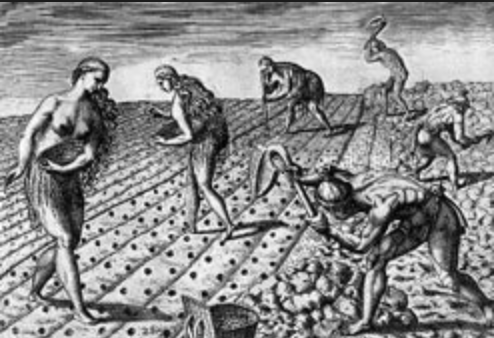
Except America wasn’t an endless expanse of forest with no certain borders. At least not while human beings inhabited it. The idea that native peoples did not cultivate or shape our land and that we had no borders is white propaganda meant to dehumanize and de-legitimize native peoples.
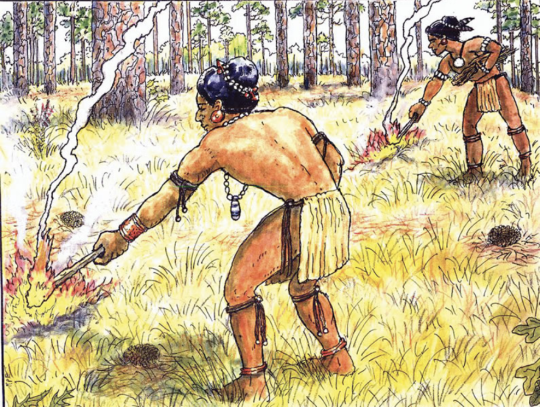
This illustration here show Apalachee people using slash and burn methods for agriculture. Fires were set regularly to intention burn down forests and plains. Why would we do this? Well because an unregulated forest isn’t that great for people, actually. We set fires to destroy new forest growth and undergrowth, and to remove trees, allowing for easier game hunting, nutrient enriched soil, and better growth rates for crops and herbs we used in food and medicine.
Pre-Colonial New England, where my tribe the Abenaki are from, looked more like an extensive meadow or savannah with trees growing in pockets and groves. Enough woodland to support birds, deer, and moose, but not too much to make hunting difficult. We carefully shaped the land around us to suit our needs as a thriving and successful people. Slash and burn agriculture was practiced virtually everywhere in the new world, from the pacific coast to chesapeake bay, from panama to quebec. It was a highly successful way of revitalizing the land and promoting crop growth, as well as preventing massive forest fires that thrive in unregulated forests. Berries were the major source of fruit for my tribe, and we needed to burn the undergrowth so they could grow.
That changed when white people invaded, and brought with them disease. In my tribe, up to 9 in 10 people died. 90% of our people perished not from violence starvation, but from disease. Entire villages would be decimated, struck down by small pox. Suddenly, we couldn’t care for the land anymore. There weren’t enough of us to maintain a vast, carefully structured ecological system like we had for thousands of years. We didn’t have the numbers, or strength. So the trees grew back and unregulated. We couldn’t set fires anymore, and we couldn’t cultivate the land. And white people would make certain we never could again. Timber, after all, was the most important export from New England.
Endless trees and untamed wilderness is a nice fantasy. But it’s a very white fantasy, one that erases the history of my people and of my land. One that paints native peoples are merely parasites leeching off the land, not masters of the earth who new the right balance of hunting and agriculture. It robs us of our agency as people, and takes our accomplishments from us. Moreover, it implies that only white people ever discovered the power to shape the world around them, and that mere brown people can’t possibly have had anything to do with changing our environment.
Don’t bring back untamed wilderness. Bring back my fire setters, my tree sappers, my farmers and my fishers. Bring back my people who were here first.
They’ve Always Been Watching Us: From COINTELPRO and Martin Luther King, Jr to the NSA’s surveillance program, the US Government has been keeping a close watch on the American Left for a long time.
I am going to print this out and plaster it everywhere I go
my heart just broke
Not gonna lie; I’m on the verge of tears right now. Because this is what I see every night when I come into work. I work at a Jewish-run elder care non-profit. Even in the memory care unit, we’re seeing a rise in the residents’ anxiety levels, to the point where they’ve had to stop turning on the TV news stations (and these residents still love the news). Multiple residents are direct survivors of the Shoah; some barely escaped, and almost all of them lost family members in death camps. One resident was one of the children saved by the Kindertransport. Many other residents tell me stories of when they were kids, how their neighborhoods were destroyed and relocated and of the siblings and parents they no longer have. One newer resident was finally starting to settle in when Charlottesville happened. Even though we immediately changed the channel, she was shaken. She was inconsolable for hours. When I left for the night, she was still crying and refused to leave her room. Even now, weeks after the direct event, she still is wary to come to programs, fearing that if she is away from her room too long that her possessions and place will be stolen from her like they were in 1938. Even with dementia, even with Alzheimers, these residents remember what happened. They cannot forget their lost loved ones. They cannot forget the things stolen from them. They cannot forget, period. Because this fight against Neo-Nazis isn’t just a theoretical thing. These groups know that people are forgetting about Shoah; they take great strength knowing that people from that generation are dying. When they regard WWII as a “dark cloud” hanging over the heads of this generation, it is not with a solemn regard, with they knowledge that we must not forget lest we repeat our mistakes. These White supremacists, these White Neo-Nazis, see Shoah remembrance as something they will gladly eradicate. When people gladly throw out the Nazi salute, chant the 14 words, or march under the banner of “hail victory,” they are two things and two things only – Nazi apologists and Nazi supporters. Shoah survivors are not gone. They are still here. We need to stop ignoring that this normalization of Nazis marching in the street harms real people. It’s not just ideas. It’s not just “free speech”. We cannot forget. We cannot forget. We cannot forget.
“My father would always say, people who practice martial arts go through three stages: seeing yourself, seeing the world, seeing all living beings.”
Based on the life story of wing chun master Ip Man, The Grandmaster is an award-winning Hong Kong-Chinese martial arts drama starring Tony Leung as Ip Man and Zhang Ziyi as Gong Er. The film encapsulates Ip Man’s life, from his peaceful marriage in Foshan to his escape to Hong Kong after the Second Sino-Japanese War and rounding out with his founding of a successful martial arts school.
The Grandmaster can be considered an unorthodox action film. Rather than focus solely on the commercial thrill of violence, it depicts wing chun as an art of caution and intelligence and the personal battles of morality that define true fighting. For instance, when Ip Man challenges the martial arts grandmaster Gong Yutian, they engage in a battle of philosophy and wits, not fists. Ip Man is later challenged by Gong’s daughter, Gong Er, and the two clash in a fight of delicacy and precision, with the terms that whoever breaks a piece of furniture during the fight loses. Gong Er’s grapple with the values behind fighting insidiously tainted by wartime’s sprawling fear is front and center in the film. Wong showcases Ip Man’s intellectual and spiritual prowess, underscoring the thoughtful fluidity lurking beneath each swift movement.
In terms of production, The Grandmaster is known for having an extensive development time. Leung reportedly spent years training in wing chun for this movie and broke his arm in the process. The Grandmaster is Wong’s most expensive production to date, and Wong cites the quickly expanding Chinese film industry as the impetus driving the dissemination of more structurally advanced Sino features around the world.
“They say I spread wing chun throughout the world. I hope that’s true. I didn’t do it to acquire renown. The martial arts should be open to all, everyone should walk the same route. It all comes down to two words: Horizontal, Vertical.”My father would always say, people who practice martial arts go through three stages: seeing yourself, seeing the world, seeing all living beings.”



 alder-knight