perfect use for a golf course. we can do this to every one.
“Food justice is a big part of who we are,” said Michael Kantor, Interim Director at Grow Dat Youth Farm, who stressed the program’s primary purpose to develop youth leadership skills. “Black farmers in particular have historically been marginalized so we create opportunities here to give young people of different races the chance to take control of food production, either here or in their neighborhoods, and increase access to fresh healthy produce—something many New Orleans neighborhoods do not have.”
Grow Dat Youth Farm partners with nine local schools to recruit around 60 high school students annually. Starting January, these youth Crew Members participate in a paid, five-month leadership program held after school and on Saturday that prioritizes diversity and inclusion. The program time is evenly split between lessons on sustainable food, cooking, and farming, and team-building and leadership exercises. Graduates of the program are invited to enroll in the next tiered leadership position as Assistant Crew Leaders; a fellowship program brings in extra help around the year.
“We are being told to eat local and seasonal food, either because other crops have been transported over long distances, or because they are grown in energy-intensive greenhouses. But it wasn’t always like that. From the sixteenth to the twentieth century, urban farmers grew Mediterranean fruits and vegetables as far north as England and the Netherlands, using only renewable energy.
These crops were grown surrounded by massive ‘fruit walls,’ which stored the heat from the sun and released it at night, creating a microclimate that could increase the temperature by more than 10°C (18°F). Later, greenhouses built against the fruit walls further improved yields from solar energy alone.
It was only at the very end of the nineteenth century that the greenhouse turned into a fully glazed and artificially heated building where heat is lost almost instantaneously – the complete opposite of the technology it evolved from.“
Why do my interests in canning, couponing, and homesteading overlap so often with blogs with titles like ‘The Obedient Housewife’?
Like, I’m like, “I want to learn to make soap and farm,” and suddenly I see 500 “traditional family” motherfuckers like no you are mistaken. I am just a simple lesbian anticapitalist looking to limit my consumerism as much as possible.
‘these fun crafts will keep your kids occupied until your husband gets home!’ no i want a clothespin crown for me
As a nerd who homesteads, let me share the data I have gathered!
First is my megalist of homesteading-related links I’ve gathered over the years. I’m a mod over at r/homesteading and this is where I’ve put a lot of good sources (not all, admittedly some are still sitting in my bookmark folder waiting to be added). The search function at reddit is wretched, but there’s also been lots of good things I’ve shared there too. Please note that many of these sources are not actual webpages, but PDFs. That’s not an accident, PDFs are where you find the really good in-depth stuff.
Many of my sources are from the Extension Service. They won’t try to relate to you based on your lifestyle or sexual identity or religion or whatever, but due to that, they also won’t be alienating you either.
The Cooperative Extension Service (US only) exists in all 50 states and in most counties. It is taxpayer funded. The Extension Service exists to help people become more self sufficient, for farmers to be more successful, for people to be healthier, for kids to be well adjusted, to figure out how to grow the best plants in your area, etc. Some county offices even offer cheap classes in things like gardening, canning, soap making, and they’re taught by people with training in these areas (I once heard a great talk on composting from a soil scientist that way). Do you want to know what type of plant something is? Do you need help figuring out a plant disease or pest issue? You can now contact them online and get great info.
I HIGHLY recommend checking out your state’s extension service website, because they do offer different types of information, depending on what is grown/raised where you are (and how well funded they are). My county extension puts out a monthly gardening newsletter, which includes a helpful ‘this is the time of the year to do —-’ part.
Here’s an example from New York – they have a calendar at the bottom, showing how they have things like hydroponic and urban agriculture workshops coming up.
Interested in raising animals? Penn State Extension is really really good. They have tons of free materials and courses available online, some I pulled for my megalist at the top of this.
National Center for Home Food Preservation – they cover the important aspects of food safety, and also have some recipes. Many state Extension Service websites will have lots more recipes.
If you have kids, check out4-H programs for them. It’s part of the local public school system here. If you’re homeschooling, you can also purchase their science-filled educational and self sufficiency materials (materials are divided by age ranges – Cloverbud Member: ages 5-8, Junior Member: ages 9-13, Senior Member: ages 14-19). One of my coworkers is in 4-H, she’s still in high school, and last year she raised an award-winning heifer.
Congress grants the money for funding these programs, and they’re connected with various universities. There’s a level of cutting edge scientific knowledge and academic rigor you don’t find in blogs or even most books. There’s LOTS of homesteading books filled with outdated information like ‘till the earth every year’ hell I still have older coworkers who do it and I’m trying to figure out how to gently tell them that they’re destroying their soil that way, and that there’s better methods now, methods grounded in science.
Seen in the window at Gulf of Maine Books in Brunswick, Maine.
Photo: Bill Roorbach
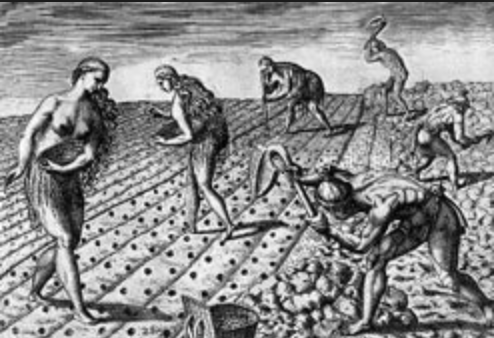
Except America wasn’t an endless expanse of forest with no certain borders. At least not while human beings inhabited it. The idea that native peoples did not cultivate or shape our land and that we had no borders is white propaganda meant to dehumanize and de-legitimize native peoples.
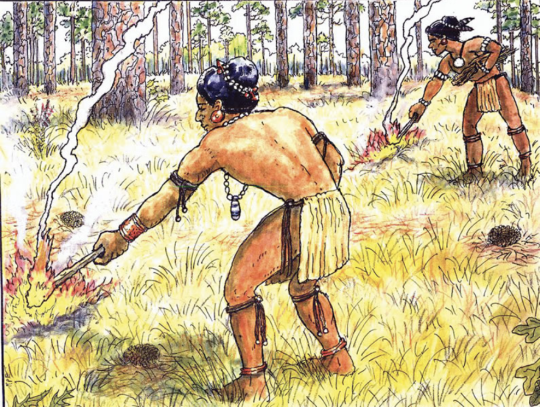
This illustration here show Apalachee people using slash and burn methods for agriculture. Fires were set regularly to intention burn down forests and plains. Why would we do this? Well because an unregulated forest isn’t that great for people, actually. We set fires to destroy new forest growth and undergrowth, and to remove trees, allowing for easier game hunting, nutrient enriched soil, and better growth rates for crops and herbs we used in food and medicine.
Pre-Colonial New England, where my tribe the Abenaki are from, looked more like an extensive meadow or savannah with trees growing in pockets and groves. Enough woodland to support birds, deer, and moose, but not too much to make hunting difficult. We carefully shaped the land around us to suit our needs as a thriving and successful people. Slash and burn agriculture was practiced virtually everywhere in the new world, from the pacific coast to chesapeake bay, from panama to quebec. It was a highly successful way of revitalizing the land and promoting crop growth, as well as preventing massive forest fires that thrive in unregulated forests. Berries were the major source of fruit for my tribe, and we needed to burn the undergrowth so they could grow.
That changed when white people invaded, and brought with them disease. In my tribe, up to 9 in 10 people died. 90% of our people perished not from violence starvation, but from disease. Entire villages would be decimated, struck down by small pox. Suddenly, we couldn’t care for the land anymore. There weren’t enough of us to maintain a vast, carefully structured ecological system like we had for thousands of years. We didn’t have the numbers, or strength. So the trees grew back and unregulated. We couldn’t set fires anymore, and we couldn’t cultivate the land. And white people would make certain we never could again. Timber, after all, was the most important export from New England.
Endless trees and untamed wilderness is a nice fantasy. But it’s a very white fantasy, one that erases the history of my people and of my land. One that paints native peoples are merely parasites leeching off the land, not masters of the earth who new the right balance of hunting and agriculture. It robs us of our agency as people, and takes our accomplishments from us. Moreover, it implies that only white people ever discovered the power to shape the world around them, and that mere brown people can’t possibly have had anything to do with changing our environment.
Don’t bring back untamed wilderness. Bring back my fire setters, my tree sappers, my farmers and my fishers. Bring back my people who were here first.
speaking of which, i hope all of my mutuals know that you can go on down to the hardware store and just buy a big ol bag of dried blood
Forbidden nesquik
Hello friends! Just a quick reminder that blood meal is dried, flash frozen blood with a high nitrogen content and added iron! If ingested it can cause iron toxicity, vomiting, pancreatitis
and other various gastrointestinal distress.
IT IS NOT SAFE FOR MAMMALS.
That being said, plants love it!
why in God’s name was it necessary for so many people to clarify that a dirty bag of blood from the gardening section isn’t safe to eat like what fucked up tumblr subculture has my shitpost reached
Today, I went around to all of the gardens or raised beds I have made with wood, and any standing decomposing pieces, and drilled some holes of varying sizes for wood-dwelling pollinators, like carpenter bees.
I finally got around to installing the bars on the top bar beehive. We had a bunch of brass cupboard handles from an old kitchen, which I screwed on to the bars to make the frames (and combs) easier to lift.
So far, this thing has been built with almost 100% salvaged materials: the only things purchased have been screws and copper nails.
Going to finally get some bees for this bad boy this year!




 alder-knight